
A Little Breeze in Our Hands
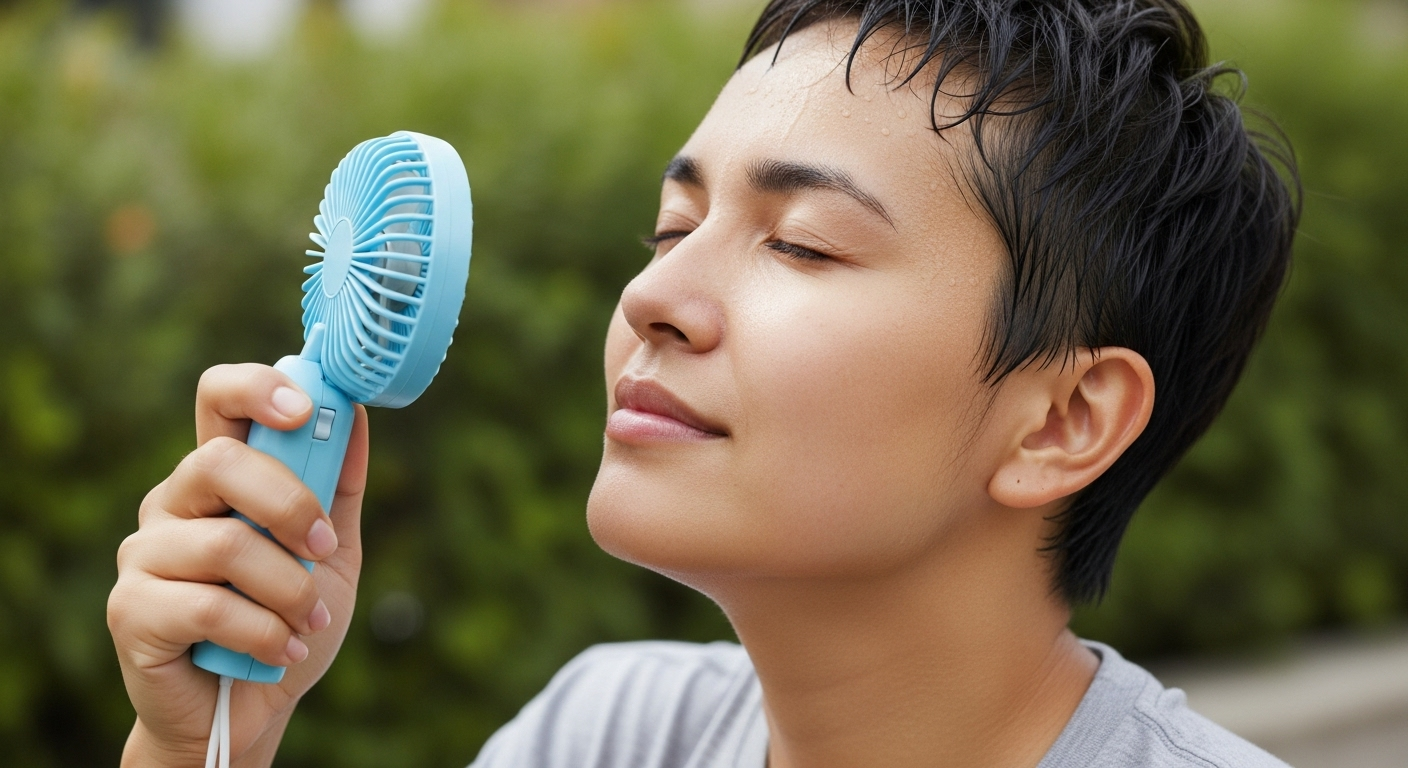
In the sweltering heat of midsummer, when the city’s asphalt breathes out scorching breaths, small wings buzz in our hands like a promise. It’s the ‘handheld fan’. The single stream of air from this small device feels like a precious shield against the stifling heat.
But what if this trusty companion turns its back on us at the hottest moment? What if, behind this cool breeze, lies a dangerous truth that threatens us? This is a journey about how this small device, which offers us brief comfort, can become our greatest enemy. What the handheld fan offers is not just simple coolness, but perhaps the “illusion of being able to control everything.”
Chapter 1: The Promise of Coolness, the Magic of Science
The Magic Word: Evaporative Cooling
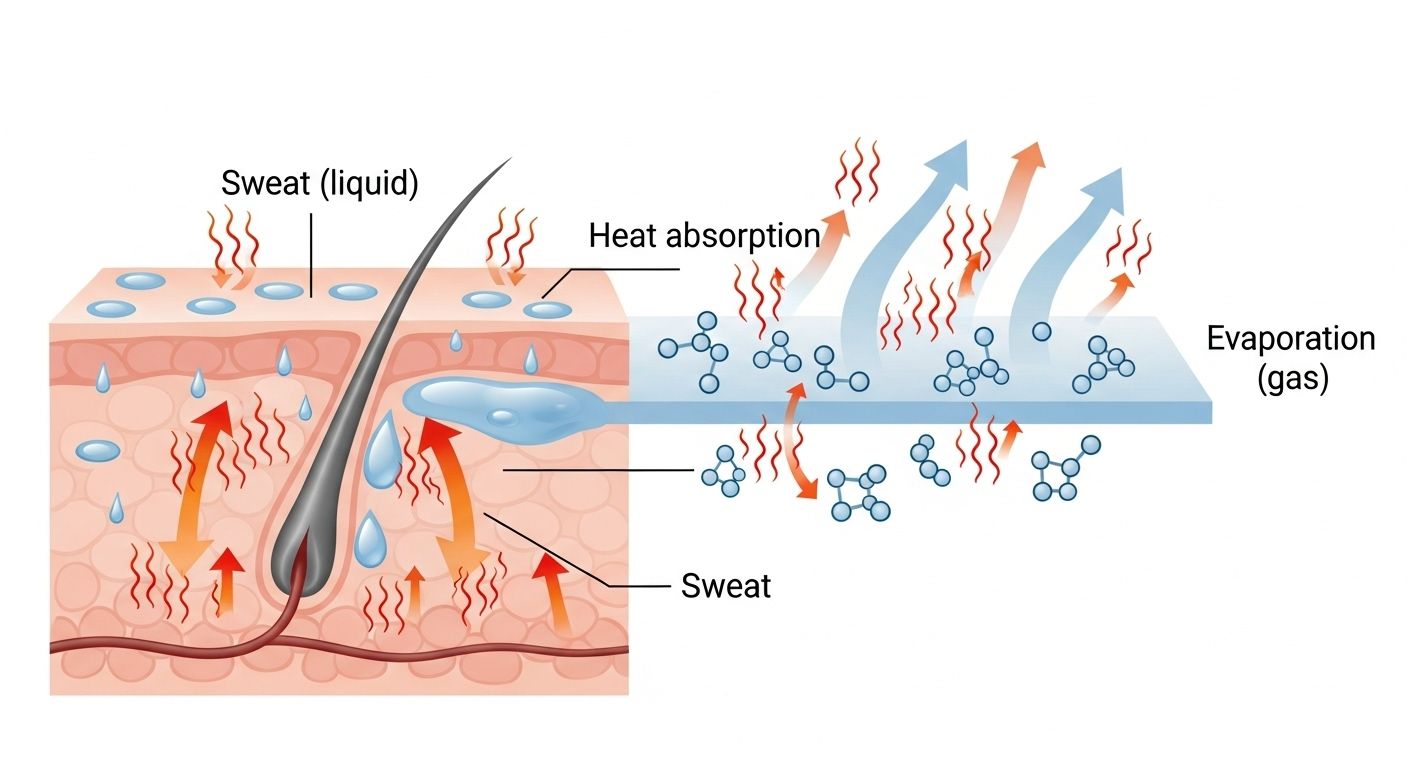
The principle behind how handheld fans cool us is simpler than you might think. A fan doesn’t actually make the air cold; it cools our bodies. The secret lies in the magic of “Evaporative Cooling.”
When our bodies get hot, we sweat, right? Fan air quickly evaporates this sweat. As liquid sweat turns into vapor, it carries away heat from our skin, and that’s when we feel “Ah, it’s cool!”
“I wish it were even colder…” You’ve all thought that at least once, haven’t you? The market responded to this desire. They incorporated “Peltier elements,” the technology used in ice makers or small refrigerators, into handheld fans. This technology, which makes one side incredibly cold when current flows through it, led to the development of cooling handheld fans that actually blow “cold air.” The phrase “an air conditioner in my hand” is quite appealing, isn’t it? However, this faith in technology made us forget the most crucial fact: “What environment am I currently in?”
Chapter 2: The Betrayer Appears, The Convection Oven Paradox
The Moment the Wind Turns
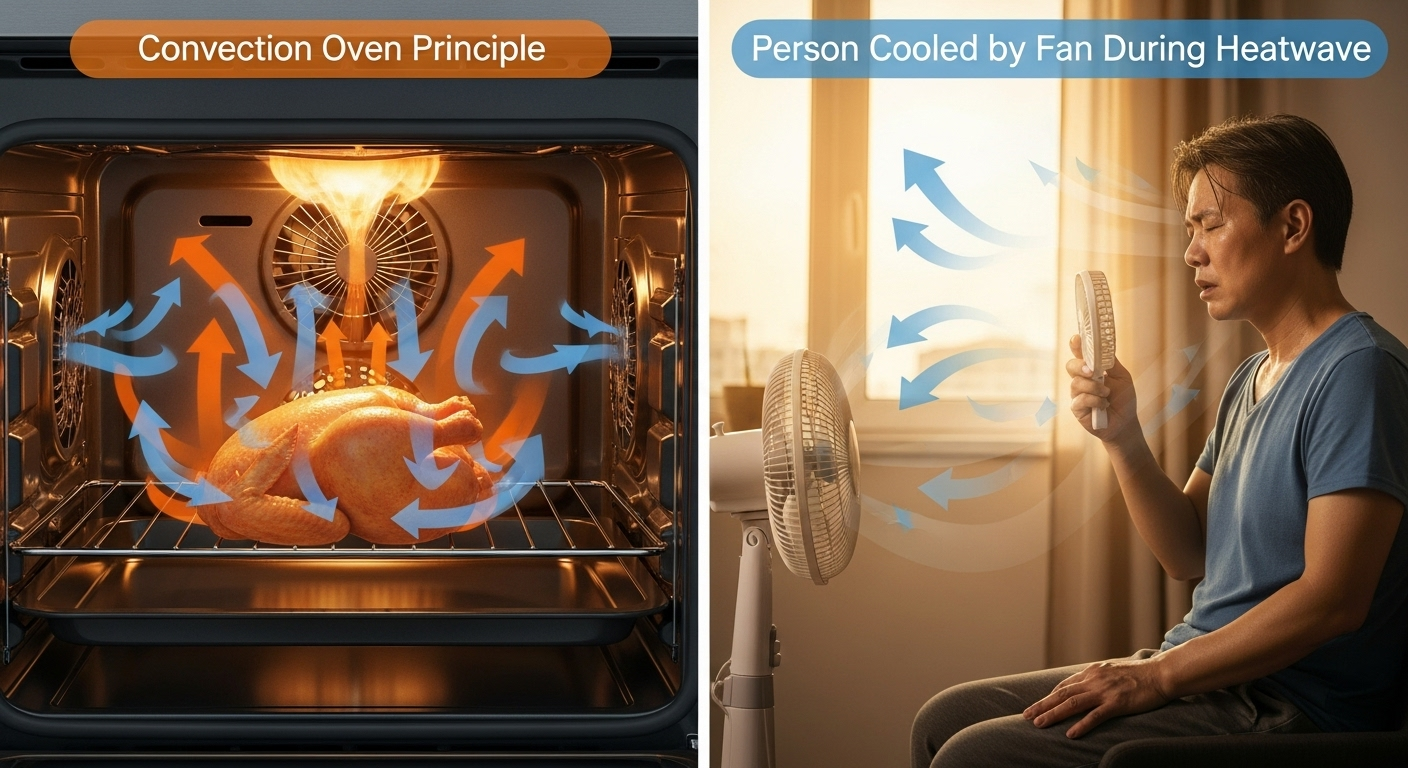
This is where the story takes a turn. What happens if the ambient air temperature around you becomes hotter than your body temperature? At this point, the handheld fan transforms from a helpful friend into an enemy that harms us. Experts call this dreadful phenomenon the “Convection Oven Effect.”
Our skin temperature is typically around 35°C. If the outside temperature exceeds 36°C or 37°C, the fan, instead of cooling our bodies, ends up blasting hot air onto us like a hairdryer. It’s akin to roasting meat with hot air in a convection oven.
The Body’s Warning Signals
In such a situation, our bodies enter a state of emergency. Due to the hot air, sweat cannot evaporate properly, and heat continues to build up inside the body. Eventually, the core body temperature rises, the heart beats faster, leading to heat exhaustion or life-threatening heatstroke.
The most terrifying aspect is that even hot air, the “air” itself, tricks our brain into thinking it’s “cool.” While the brain feels fine, the body is slowly deteriorating – the “illusion of safety.” This is why fans during a heatwave can be called “silent killers.”
Chapter 3: The 35°C Truth Game
The Old Rule: “Stop Above 35°C”
For a long time, many organizations, including the World Health Organization (WHO), advised against using fans when the temperature exceeded 35°C. This was due to the “Convection Oven Effect” explained above. This was a firm rule that almost everyone knew.
A New Challenge to the Rule
However, in 2021, a research team from the University of Sydney in Australia questioned this long-standing rule. They stated, “The safety limit for fans is not always 35°C!” The research team’s argument was that what truly matters is not just the number on the thermometer, but “ambient humidity and an individual’s ability to sweat.”
In a dry environment where sweat can evaporate easily, fans can still help us even if the temperature far exceeds 35°C. They proposed different safety standards depending on the situation.
| User Profile / Condition | Traditional Recommendation (°C) | Sydney University Research Team Proposal (°C) | Key Deciding Factor |
|---|---|---|---|
| General International Guidelines | Approx. 35 | - | Ambient Temperature |
| Healthy Young Adults | Approx. 35 | 39 | Sweating Capacity and Humidity |
| Healthy Elderly | Approx. 35 | 38 | Sweating Capacity and Humidity |
| Elderly Taking Certain Medications | Approx. 35 | 37 | Medication-induced suppression of sweating |
These complex research findings raise an important question for us: Should we follow a simple rule that applies to everyone, or should we seek the precise truth that fits our situation, even if it’s a bit more complicated?
Chapter 4: A Young Life Lost in the Heat
Behind every scientific debate, there is always a human life. The tragedy of Mr. K, a 27-year-old man in the summer of 2024, shows how close all these stories are to our reality.
On that day, the middle school cafeteria in Jeonnam felt like a giant steamer. Although the outside temperature was 34.4°C, the temperature inside the sealed space without air conditioning must have been much higher. The only cooling equipment there was just two fans.
Mr. K collapsed while working on installing air conditioning. He exhibited typical heatstroke symptoms like rambling and vomiting, but unfortunately, his colleagues did not immediately recognize the severity of the situation. By the time he reached the hospital, his body temperature exceeded 40°C, making it impossible to measure, and he never opened his eyes again.
Mr. K’s death was not a mere accident. It was a preventable tragedy. And in his story, the two fans circulating in the stuffy cafeteria might not have cooled his body, but perhaps acted as a ‘convection oven,’ blowing hot air and putting him in greater danger.
Chapter 5: The Wisdom of Taming the Breeze
We must now learn how to wisely manage this little breeze. The principles commonly emphasized by experts, including the Korea Disease Control and Prevention Agency, are clear.
- Fans are supporting players: You cannot rely solely on a fan during a heatwave. The main players are air conditioners or cool places.
- Use with water: Wrap a wet towel around your neck or spray water on your body with a mist bottle and then feel the breeze. This is the best way to maximize the evaporative cooling effect.
- Ventilation is essential: Use it while opening windows to allow hot air to escape.
- The best emergency tool: If someone develops a heat-related illness, wetting their body with cool water and fanning them is the most effective first aid for rapidly lowering body temperature.
In conclusion, a fan is not a “magic bullet” that solves everything, but a “helper” that magnifies the effectiveness of other cooling methods several times over.
You, Armed with Information
So, let’s return to the initial question: “Is using a handheld fan during a heatwave good or bad?”
The answer is “It completely depends on when, where, and how you use it.”
We now know both faces of the handheld fan. From the image of a friend we naively trusted to the paradox of a convection oven that threatens us. We have also learned that beyond the simple rule of 35°C, humidity and our body’s condition are more important variables.
Now, we are smart users armed with information. Finally, we conclude this story by summarizing clear action guidelines for you.
✅ Must Do (DOs)
- Use when the temperature is below your safety limit (37-39°C for healthy adults) and you are sweating.
- Always use with water. With wet towels, mist bottles, etc., it becomes the best cooling system.
- Use for ventilation. It is especially useful for drawing cool night air indoors.
❌ Absolutely Not (DON’Ts)
- Do not rely solely on a fan in high temperatures above 35°C, especially in sealed spaces without ventilation.
- Do not solely trust the sensory coolness of the breeze; develop a habit of checking the actual temperature and humidity.
- Never take symptoms like dizziness or rambling due to heat illness lightly. It is an emergency situation that requires immediate reporting to 119.
On the sweltering city streets again, you pick up your handheld fan. But now, you don’t mindlessly turn it on. You check the temperature and humidity, listen to your body’s signals, and make a wise decision on how to manage this little breeze. The small handheld fan is no longer a magical amulet, but a precious tool that we must use with respect and understanding in a warming world.