
From the Ghost of Bakhmut to Virtual Battlefields: Everything About Technology That Replicates Reality
The digital twin technology, which replicates everything in the real world into virtual space, is fundamentally shaking the paradigm of warfare. This article delves into how digital twins are redefining everything in the military field, from individual soldiers to entire battlefields and even competition between nations.
- The concept and operational principles of digital twins that replicate soldiers, equipment, and battlefields
- The ‘decision dominance’ that changes the pace of war and the geopolitics of digital arms races
- New ethical and strategic risks posed by technology and future challenges
The Ghost of Bakhmut: The Digital Twin of a Soldier
In the dim dawn outside the ruined city of Bakhmut in eastern Ukraine, veteran scout Major Oleksandr Kovalenko is holding his breath, making final preparations for his mission into enemy territory. His task is simple yet deadly: to confirm the enemy’s new supply route and send the coordinates.
However, in a command control room hundreds of kilometers away in an underground bunker, a completely different dimension of operations is unfolding. What appears on the large screen is not just a simple satellite map. It is Major Kovalenko’s ‘Humanoid Digital Twin.’
This is a virtual avatar that replicates him in real-time, composed of vast amounts of data.
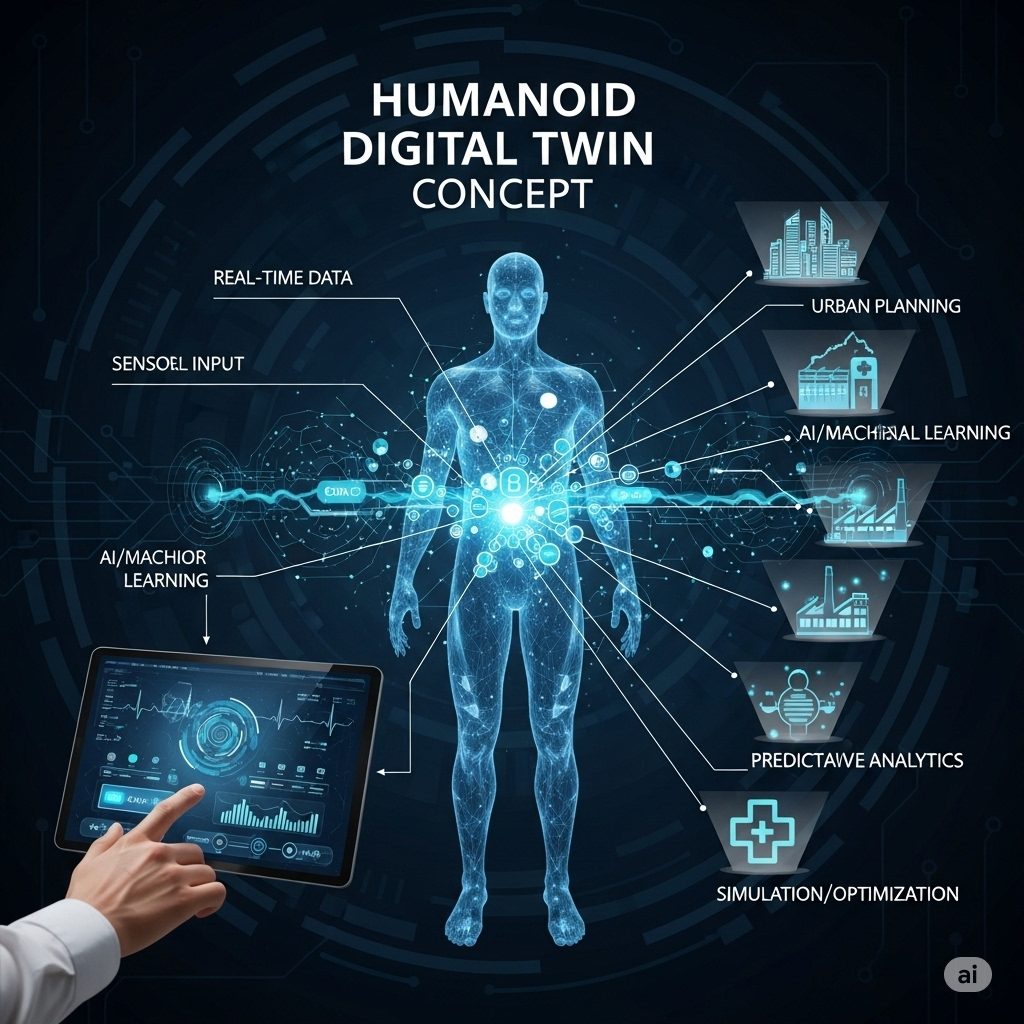
- Biometric Data: The wearable sensors Kovalenko wears transmit biometric signals such as his heart rate, body temperature, and stress levels in real-time. Operation planners are checking numerically when his physical limits will be reached.
- Past Mission Data: His shooting accuracy, endurance, and decision-making patterns under pressure, accumulated from past training and real missions, have been analyzed by AI.
- Biomechanical Model: A physics-based model of his body simulates how the newly issued equipment will affect his stamina over a 12-hour mission and how much it increases the risk of injury.
Commanders use this digital twin to conduct dozens of virtual rehearsals before the actual mission begins. In a virtual battlefield reconstructed in 3D from photos taken by satellites and drones, Kovalenko’s avatar attempts various infiltration routes, responds to predicted enemy ambushes, and finds the optimal combination of equipment. This allows them to identify weaknesses in the operation plan without exposing a single soldier to danger.
The scene in this small operations room symbolically illustrates how the Russia-Ukraine war has become a massive experiment in new technologies combining AI and space assets. Here, we witness a fundamental change in the nature of warfare. While past armies sought to enhance soldiers’ capabilities through training and equipment, they now view each soldier as an analyzable system.
However, this technology raises profound ethical questions. A digital twin containing a soldier’s most intimate biometric and psychological data could become a ‘digital dog tag’ that follows him for life. Who owns this data after discharge, and is there a risk of it being misused by adversaries or commercial enterprises? Perhaps this technology could reduce soldiers to a collection of variables to be optimized, accelerating the dehumanization of warfare.
What is a Digital Twin? Differences from Simulation
To understand what a digital twin is, we must first clarify how it differs from the ‘simulation’ we commonly know. A digital twin is a digital replica that replicates physical assets or systems from the real world into virtual space, and the key is that it is constantly updated with real-time data transmitted from real objects.
Let’s examine this difference through analogies in a military context.
- Simulation: A flight simulator is a type of ‘simulation.’ It allows pilots to practice ‘what could happen’ in a virtual scenario based on a general model of an F-35 fighter jet. This model is static and not directly connected to a specific real fighter jet.
- Digital Twin: In contrast, the digital twin of a ‘specific F-35 fighter jet (tail number X)’ performing a real mission over the South China Sea is a completely different concept. This virtual fighter receives vast amounts of real-time data from thousands of sensors attached to the real aircraft, such as engine temperature, fuel consumption, airframe fatigue, and radar performance. In other words, it accurately shows ‘what is happening right now’ and predicts the next moment.
The most important difference is that the flow of data is bidirectional. Data flows from the real fighter to the virtual twin, and information or commands analyzed and optimized in the virtual twin can be sent back to the real fighter.
These digital twins are structured hierarchically, like LEGO blocks.
- Component Twins: Each turbine blade of a jet engine is virtually replicated.
- Asset Twins: A complete jet engine made up of several components becomes one ‘asset twin.’
- System Twins: An F-35 fighter jet, which combines engines, avionics, and weapon systems, constitutes a ‘system twin.’
- Process Twins: The operation of an entire airbase, where multiple fighters, control towers, and logistics support systems work together, is implemented as a ‘process twin.’
Simulation vs Digital Twin
| Attribute | Simulation | Digital Twin |
|---|---|---|
| Data Connection | Unidirectional (manual data input) | Bidirectional (real-time, continuous sensor data feed) |
| State | Static & Virtual (“What if ~?”) | Dynamic & Real (“Right now ~.”) |
| Scope | Usually limited to a single process or event | Entire lifecycle of a specific asset |
| Main Use | Training and design exploration | Real-time monitoring, prediction, and optimization |
| Military Analogy | General tank gunnery training simulator | Real-time virtual model of ’that tank’ in the field (showing fuel, ammunition, system status) |
Virtual Battlefield and JADC2: The Race for God’s Eye View
Digital twin technology is moving toward the ultimate goal of replicating the entire battlefield in real-time, known as the ‘Virtual Battlespace.’ This is not just a simple 3D map but another world that breathes and synchronizes with reality.
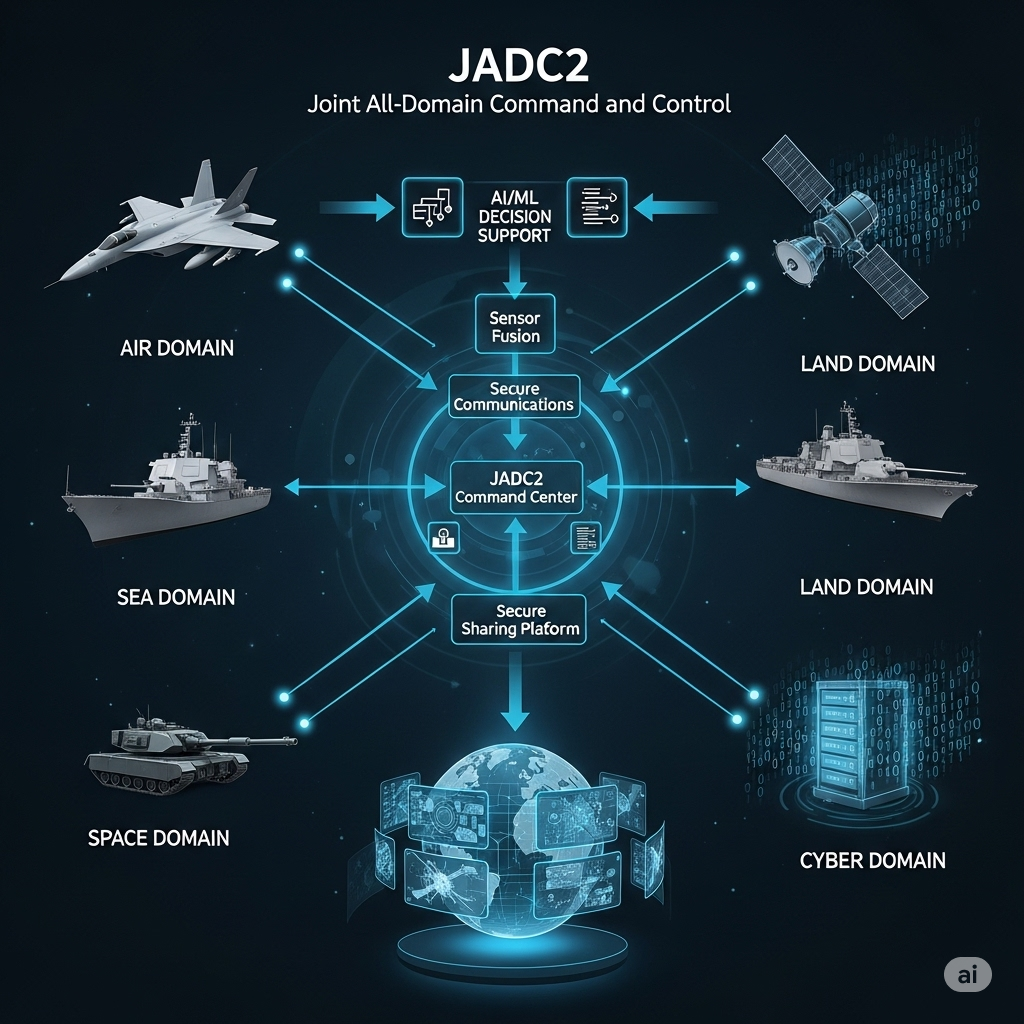
JADC2: The Neural Network of Modern Warfare
At the center of this grand vision is the core concept of the U.S. Department of Defense, ‘Joint All-Domain Command and Control (JADC2).’ The goal of JADC2 is to connect all sensors from all domains—Army, Navy, Air Force, Space Force, and Cyber Force—into one massive network.
The virtual battlefield is an essential foundation for implementing this JADC2. The virtual world, where all elements of the battlefield are represented as digital twins, provides the perfect data needed for AI to analyze and make judgments.
Compressing the OODA Loop: Superhuman Decision Speed
Victory or defeat in war often depends on the speed of the ‘OODA Loop.’ The OODA Loop is a decision-making cycle that follows Observe → Orient → Decide → Act, and the side that can complete this cycle faster than the enemy gains the upper hand in battle.
Digital twins and AI compress this OODA Loop to a speed that transcends human limits, creating a ‘Super OODA Loop.’
- Observe: Thousands of sensor data are integrated in real-time into the digital twin of the battlefield.
- Orient: AI analyzes the digital twin to identify enemy patterns and predict the next moves.
- Decide: AI simulates various scenarios and presents the optimal course of action to commanders.
- Act: The network automatically assigns missions to the most effective weapon systems to strike targets.
The ultimate goal of this entire process is to secure ‘Decision Dominance.’ This means making better decisions before the enemy can understand and respond to the situation, keeping them in a state of continuous confusion and paralysis.
However, this also gives rise to a new form of deadly vulnerability known as ‘Cognitive Warfare.’ Now, the enemy can manipulate the data supplied to the digital twin without needing to destroy friendly tanks. By injecting distorted data, they can make friendly AI chase illusions and ignore real threats.
Digital Engineering: Weapons Born in the Virtual
Digital twins enable ‘digital engineering,’ which innovates the entire process of designing, producing, and maintaining military equipment, going beyond merely replicating the battlefield to ‘cradle-to-grave’ management.
Case 1: B-21 Raider - The Birth of an Invisible Bomber
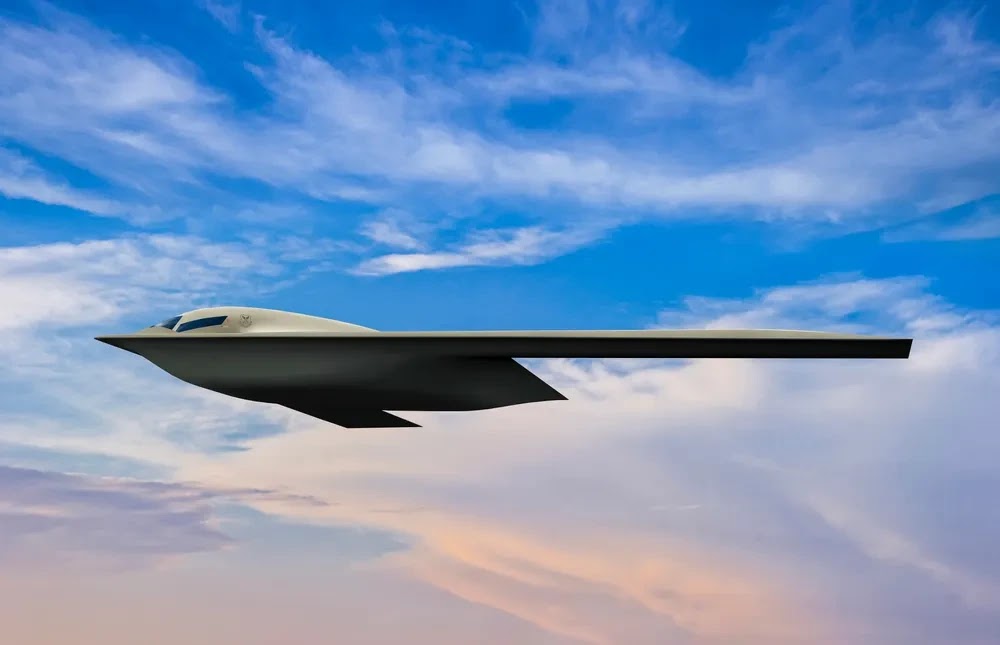
Dubbed the ‘world’s first sixth-generation aircraft,’ the B-21 Raider was born entirely in a digital environment. Northrop Grumman repeatedly tested thousands of designs through computer simulations before cutting any metal. Thanks to this digital twin approach, they could quickly identify and correct issues in the early stages of development, resulting in a significant reduction in development time and costs compared to the past B-2 bomber.
Case 2: F-35 - Taming a $1.58 Trillion Fighter
To manage the astronomical maintenance costs of the F-35 fighter program, each F-35 fighter has its own ‘Structural Digital Twin.’ AI analyzes the data from this digital twin to perform ‘Predictive Maintenance,’ predicting potential failures before parts break down. This allows for proactive repairs, reducing downtime and saving enormous costs.
Case 3: Europe’s Digital Front - Competition Among Allies
These changes are not limited to the U.S. The ‘Tempest’ fighter jet jointly developed by the UK, Italy, and Japan, as well as France’s ‘Scorpion’ armored vehicle modernization program, also consider digital twins as a core technology.
However, this digital-first approach raises significant long-term issues of ’technological dependency’ and ‘data ownership.’ Companies that build and manage the digital twins of specific weapon platforms will hold immense power over the entire lifecycle of that platform, complicating partnerships among allies.
Avatar Soldiers and the Future of Human-Machine Teams
Returning to the smallest unit of the battlefield, the soldier, when I first encountered the concept of the Humanoid Digital Twin (HDT), it felt like a scene from a science fiction movie. However, it is already becoming a reality.
Hyper-Personalized Training and Virtual Reality Rehearsals
HDT can analyze individual soldiers’ learning speeds, biometric responses, strengths, and weaknesses to provide extremely personalized training programs. Furthermore, by implementing a digital twin created by scanning actual operation areas with drones and satellites into a VR/AR environment, soldiers can achieve the effect of ’training directly in the target area’ without leaving the base.
Data-Driven Squad Command
Commanders can objectively assess the fatigue, stress levels, and mission readiness of their soldiers through a ‘squad dashboard’ that receives data from the soldiers’ digital twins, allowing for data-based command decisions.
The Birth of Human-Machine Teams
Moreover, HDT becomes the key interface that integrates human soldiers into autonomous system networks. The soldier’s digital twin transmits his intentions and status in real-time to robotic ’team members.’ In the U.S. Army’s ‘Project Convergence’ training, experiments are already underway where soldiers operate alongside robotic mules or reconnaissance robots.
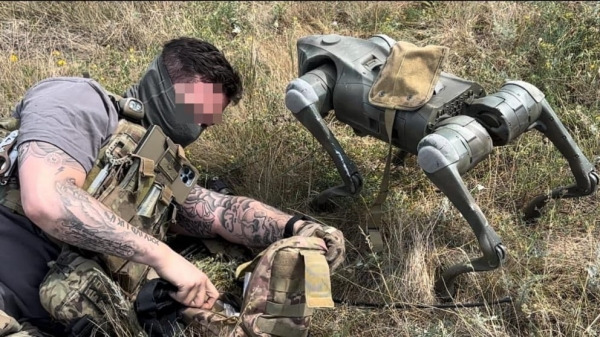
In this ‘Human-Machine Teaming,’ humans make the final decisions while machines take on dangerous and arduous tasks. This signifies a transition from ‘human-in-the-loop,’ where humans control everything directly, to ‘human-on-the-loop,’ where they supervise machines that act autonomously.
However, this deep integration creates a dangerous trap known as ‘Automation Bias.’ If AI always suggests the ‘optimal’ course of action, soldiers may risk losing their ability to make independent judgments.
New Geopolitics: The Digital Twin Arms Race
Digital twin technology acts as a geopolitical variable reshaping the balance of power between nations. The ability to develop and operate digital warfare technologies itself is becoming a new measure of national power.
- The U.S. and NATO: Leading the establishment of a unified and interoperable system that encompasses allied nations through JADC2, aiming for an open and allied model.
- China’s ‘Intelligent Warfare’: Adopting a strong, state-led centralized approach, developing the concept of ‘Battleverse’ that merges military and civilian technologies.
- Russia’s Asymmetric Approach: Focusing on threatening the data integrity of the West’s networked digital twin systems through information warfare and cyberattacks rather than developing cutting-edge technologies.
This competition could deepen the ‘Digital Twin Gap’ between nations and lead to a new form of ‘Virtual Colonialism,’ where powerful countries with overwhelming platforms impose technological dependency on their allies.
The Paradox of Perfect War: The Dangers of Digital Twins
The promise of efficient and precise warfare that digital twins offer comes with a paradox: their perfection could make them even more dangerous.
Fragile Sword: Cybersecurity Threats
The digital twin connecting the entire battlefield becomes a massive attack surface in itself. If an adversary injects false data into the digital twin (data integrity attacks) or seizes control of the system (system takeover), it could lead to catastrophic consequences.
Escalation Engine: Risks of Misjudgment
If digital twin simulations predict a ‘clean and swift victory,’ leaders may underestimate the uncertainties of war and feel tempted to hastily engage in conflict. Using digital twins in scenarios related to nuclear weapons, in particular, could dangerously lower the threshold for nuclear use in crisis situations.
Moral Hazard: Gamification of War
When warfare is commanded through a virtual battlefield that resembles a video game, ethical concerns arise about commanders becoming desensitized to the horrific consequences in the real world.
Conclusion
Digital twins are a powerful tool that can change the future of warfare, but they also harbor new risks. The key lies not in the technology itself, but in how we choose to use this powerful ‘mirror of reality.’
- Personalized Warfare: Digital twins have the potential to optimize individual soldiers and reduce casualties through virtual rehearsals.
- War of Speed: By replicating the entire battlefield in real-time and analyzing it with AI, decision-making can occur at speeds that surpass human limits.
- Invisible Warfare: ‘Cognitive warfare’ through cyberattacks and data manipulation becomes central to new conflicts, and technological gaps may lead to new geopolitical tensions.
Ultimately, we must be wary of the paradox that the technology created to clear the ‘fog of war’ could instead create a denser ‘fog of certainty’ that leads us to believe we know everything. Do you think technology will accelerate the dehumanization of warfare, or will it become a tool for saving lives?