
This article provides an in-depth analysis of how the UK is resetting its relationship with the EU amid economic and geopolitical crises following Brexit.
- The tangible impact of Brexit on the UK economy
- How geopolitical crises (the Ukraine war, Trump) have altered the UK’s foreign policy strategy
- The effect of the UK’s ’nuclear card’ on resetting relations with the EU
Eight Years After Brexit: The Shadow of Regret
In a pub in the northeastern port city of Grimsby, England, the evening fog begins to settle. Arthur, 58, who runs a small seafood processing plant, fiddles with his beer glass, lost in thought. Grimsby was a place that overwhelmingly supported Brexit, or the exit from the European Union (EU), during the 2016 referendum. Arthur was one of them. But now, eight years later, the term ‘Bregret’, a portmanteau of Brexit and regret, bitterly lingers in his mind.
Arthur sighs as he complains to a friend about the electricity bill for running the factory’s freezer and the skyrocketing price of a pint of beer. This reflects a facet of the chronic inflation weighing down the UK economy. The bigger issue is sending smoked fish to his long-time French client. Before Brexit, it was no different from sending goods to London, but now he is plagued by mountains of paperwork and customs procedures. Instead of the promised ‘rosy future’ from Brexit, only a bitter reality remains. I vividly remember watching the vote count in 2016 with a sense of disbelief.

At that moment, the pub’s television screen shows scenes of joint military training between British and French forces. In recent days, news of Russia’s invasion of Ukraine and the unpredictable American president has been pouring in, and ironically, Arthur feels a strange sense of relief watching that scene. It hints at the core tension this article will explore: how economic isolation and geopolitical crises are pulling the UK back onto the European trajectory.
A Divided Kingdom: Causes and Consequences of Brexit
Brexit Vote: What Divided the UK?
On June 23, 2016, the UK decided to leave the EU by a narrow margin of 51.9% to 48.1%. This decision was not merely a reaction to immigration issues; it revealed a deep fissure that had long been simmering within British society.
The voting results starkly divided along lines of education level, income, age, and social status. Low-income, older, and less-educated voters were more likely to support leaving, reflecting the anger of those who felt ’left behind’ for decades. Areas like Grimsby, once industrial hubs, known as the ‘Red Wall’, have continued to decline. In contrast, the southeastern region centered around London has thrived on finance and service industries. This extreme regional imbalance fostered a perception of being ’left behind by globalization,’ leading to resentment towards Brussels’ elite bureaucracy.
The immigration issue exacerbated these grievances. Since 2004, the influx of low-wage workers from Eastern European countries joining the EU has heightened the anxieties of residents in declining areas already struggling with job shortages and deteriorating public services. The slogan of the Leave campaign, “Take Back Control,” was powerful, appealing to those who refused to be mere cogs in the EU machine and evoking a desire for sovereignty among those who remembered the glory of the British Empire.
The Harsh Cost of ‘Regaining Sovereignty’: The Economic Shock of Brexit
The cost of ‘regaining sovereignty’ has been severe. The UK economy has faced ongoing difficulties since Brexit, directly impacting the daily lives of small business owners like Arthur.
Trade Barriers and Investment Drought The Trade Cooperation Agreement (TCA) between the UK and the EU eliminated tariffs on most goods but created a new mountain of ’non-tariff barriers.’ Complex customs paperwork, origin regulations, and health and quarantine procedures imposed new administrative costs and delays on Arthur’s factory. As a result, small EU customers unable to bear the hassle ceased trading, and in fact, the diversity of UK exports to the EU decreased by 30% in the first year after Brexit. The Office for Budget Responsibility (OBR) projected that Brexit would lead to a long-term reduction of 4% in the UK’s GDP and a 15% drop in trade volume.
Inflation and Labor Shortages Brexit has further exacerbated the UK’s chronic inflation. Complicated supply chains and rising import prices due to the weakening pound have led to the highest inflation rates among major advanced economies. At the same time, the end of free movement for EU citizens resulted in severe labor shortages in specific sectors such as transport, hospitality, and food processing.
The Northern Ireland Issue The most complex issue has been Northern Ireland. To avoid establishing a physical border between British-ruled Northern Ireland and EU member Ireland, the ‘Northern Ireland Protocol’ was adopted, keeping Northern Ireland part of the EU single market. This resulted in a de facto customs border between Great Britain and Northern Ireland, causing serious political conflict. Ultimately, the UK and the EU had to seek practical solutions through a new agreement known as the ‘Windsor Framework.’
| Comparison of UK Economic Indicators Before and After Brexit | ||
|---|---|---|
| Indicator | Before Brexit (Average 2015-16) | After Brexit (Average 2022-24) |
| GDP Growth Rate | 2.1% | 0.5% |
| Proportion of Trade with the EU | 48.4% (2015) | Approximately 41% (estimated) |
| Consumer Price Inflation Rate (Annual Average) | 0.35% | Approximately 7.9% |
Thus, the economic outcomes of Brexit, contrary to the promises of ‘sovereignty’ and ‘prosperity,’ have resulted in economic friction and loss of competitiveness. The weakened economic power has placed the UK’s geopolitical isolation in a precarious state, beginning to exert pressure to fundamentally reconsider its foreign policy strategy.
Turning Crisis into Opportunity: Strategic Shift in Post-Brexit Britain
Geopolitical Storm: The Variables of Russia and the US
The optimistic worldview that underpinned the Brexit project has been shattered by two external shocks.
The first is Russia’s full-scale invasion of Ukraine. The war, which began in February 2022, fundamentally shook the security landscape of Europe. For the UK, this war has awakened the harsh reality that conventional warfare among great powers has returned to the European continent. The geographical separation from Europe has lost all strategic significance.
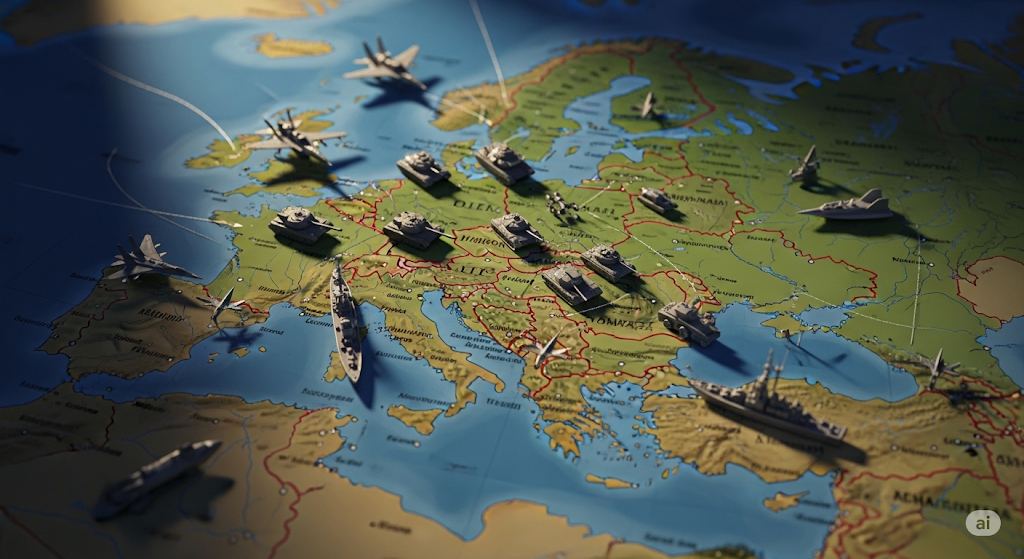
The second is the shadow of ‘America First.’ The presidency of Donald Trump and the possibility of his re-election raised serious questions about the security guarantees from the US, which have been the foundation of European security for the past 75 years. Trump criticized NATO members for their insufficient defense spending, shaking the collective defense clause (Article 5). This urgency has led to discussions within Europe about the need for ‘strategic autonomy’ independent of Washington.
In this context, the UK’s initial Brexit strategy of ‘Global Britain’ seemed detached from reality. Security plans in the North Atlantic became a far more pressing issue than trade agreements with New Zealand.
The UK’s Bold Move: The Nuclear Card as the Center of European Security
Cornered strategically, the UK made a bold proposal towards Europe. This was a highly strategic gamble aimed at resetting relations with the EU and regaining influence on the international stage.
The crux was the ‘Northwood Declaration,’ in which the UK and France agreed for the first time to coordinate their independent nuclear deterrents. In this declaration, the UK stated that its nuclear capabilities protect Europe from “extreme threats.” This effectively suggested a nuclear umbrella for the EU. It resembles an ace player who had left the team proposing to collaborate again using their specialty in a crucial game.
The UK’s ‘calculation’ is multifaceted.
- Return as a Key Player: By circumventing the economic agenda placed in a weaker position post-Brexit, the UK aims to leverage its unique status as the only nuclear power in Europe to return to the highest decision-making table of European security.
- Strengthening Actual Security: Strengthening Europe’s deterrence in the face of Russian threats and American uncertainties directly relates to the UK’s own security.
- Laying the Foundation for New Relations: The intention is to wash away the grievances accumulated during the Brexit process and build a positive relationship between the UK and the EU based on shared security interests.
If you were a leader of a European country, how would you evaluate the UK’s proposal? In Germany, voices are already emerging that discussions on nuclear sharing with the UK and France are necessary to complement the US nuclear umbrella, indicating that tectonic shifts in European security policy have begun.
| Comparison of Major Countries’ Nuclear Forces (Estimates) | ||
|---|---|---|
| Country | Estimated Number of Nuclear Warheads | Major Delivery Systems |
| UK | Approximately 260 | Submarine-launched ballistic missiles (SLBM) |
| France | Approximately 290 | SLBM, air-launched cruise missiles |
| Russia | Approximately 5,459 | ICBM, SLBM, strategic bombers |
| US | Approximately 5,177 | ICBM, SLBM, strategic bombers |
In conclusion, the UK’s nuclear card has been a very clever strategic choice that flips the economic weaknesses post-Brexit into military strengths, transforming the narrative of isolation and decline into one of power and necessity.
Towards New Partnerships After Brexit
Moving Beyond Conflict to Practical Cooperation
With security as a new focal point, the relationship between the UK and the EU has begun to transition from long-standing conflicts to practical cooperation. The resolution of the Northern Ireland issue, once the biggest stumbling block, through the ‘Windsor Framework’ agreement was a decisive turning point.

Based on this, specific collaborations such as youth exchange programs, simplification of trade procedures for certain goods, and the UK’s participation in the EU’s joint research program (Horizon Europe) have been initiated. This indicates the formation of a new type of ‘structural partnership’ that is far from the ‘complete break’ envisioned by Brexit hardliners. The UK is becoming intricately woven back into the fabric of the EU through security, research, and specific economic sectors, outside the core political and economic union of the EU.
Returning to Arthur’s story, he reads in the newspaper about the recently announced simplification of food export procedures. While this cannot turn back the clock to before Brexit, it can significantly help him maintain his long-standing relationship with his French client.
Conclusion: The Long Shadow of Brexit and New Paths
A year later, Arthur finds himself sitting in that pub again. His business is still tough, but thanks to the new agreement with the EU, he has some breathing room. On the television, the UK Prime Minister stands alongside the leaders of France and Germany discussing European security. This scene succinctly encapsulates the journey of the UK post-Brexit. The glamorous dream of ‘Global Britain’ has been replaced by the realization that security and prosperity in the 21st century is a ’team sport’ that cannot be achieved alone.
The key points of this article can be summarized as follows:
- Economic Reality: Contrary to promises, Brexit has deepened economic difficulties and social divisions.
- Geopolitical Shift: Russia’s invasion and American uncertainties have led the UK to move from isolation to security cooperation with Europe.
- Strategic Reset: The UK is seeking to reset its relationship with the EU using its nuclear deterrent as leverage, aiming for a new ‘structural partnership.’
Having left the family table of Europe, the UK now realizes the necessity of rejoining the neighborhood watch. What does the UK’s case suggest to us? If you want to know more about the changing European landscape and its potential impact on the Korean Peninsula, I recommend reading related articles: [The Future of the European Union and Strategic Autonomy].
References
- “Brexit, UK Trade Impact, Inflation Deepening… Workers and Businesses Suffer” Korea International Trade Association
- UK’s Economic Crisis… Was This the Reason for Pushing Brexit? Sisa Journal
- The Process, Issues, and Implications of Brexit National Assembly Legislative Research Service
- UK’s Regional Disparities, Brexit, Regional Development Policy Trends, and Implications Korea Research Institute for Human Settlements
- A Wrong Farewell to the EU… The ‘Lost Decade’ Left by Brexit Chosun Ilbo
- Post-Brexit UK Economic Situation and Financial Industry Evaluation and Implications Korea Institute for International Economic Policy
- Economic Decline… UK Makes a ‘U-Turn’ After 5 Years of Brexit Munhwa Ilbo
- One Year After Brexit, Prospects for the UK Economy and EU Relations KOTRA
- The Russia-Ukraine War and Changes in the European Security Landscape Institute for Foreign Affairs and National Security
- Can France and the United Kingdom Replace the U.S. Nuclear Umbrella? CSIS
- The UK, Isolating Itself with Brexit, is Now Seeking to Reestablish Relations with the EU Using Nuclear Weapons as Leverage Weekly Dong-A
- UK Prime Minister Visits Ireland to Restore ‘Brexit Conflict’ Yonhap News