
An in-depth analysis of the revival of a massive project that has been dormant for decades and its geopolitical ramifications.
- Background and current status of the Alaska LNG project, which has been stalled for decades.
- The different geopolitical calculations faced by Korea and Japan amid U.S. trade pressures.
- Expected scenarios for Korea’s participation in the project, including potential opportunities and critical risks.
The Alaska LNG Project, which has been adrift for decades, is once again emerging at the center of the international energy market, thanks to the emergence of private developers and strong political backing. This is not just an energy development project; it is a complex narrative intertwined with the energy security of Korea and Japan and the geopolitical interests of the United States.
1. The Dawn of the Alaska LNG Project’s Revival
The Alaska LNG project has a long history spanning over 10 years. Initially led by major oil companies like BP and ExxonMobil, it faced a crisis when they withdrew in 2016. Subsequently, the Alaska Gasline Development Corporation (AGDC) took the lead but seemed to be stalled due to funding failures.
A decisive turning point came in March 2025 when the private developer Glenfarne Group acquired a 75% stake in the project. The Glenfarne Group, with experience in multiple projects like Texas LNG, has injected new momentum into the project. Notably, the strong support from the Trump administration clearly indicates that this project is not merely a commercial venture but a national priority.
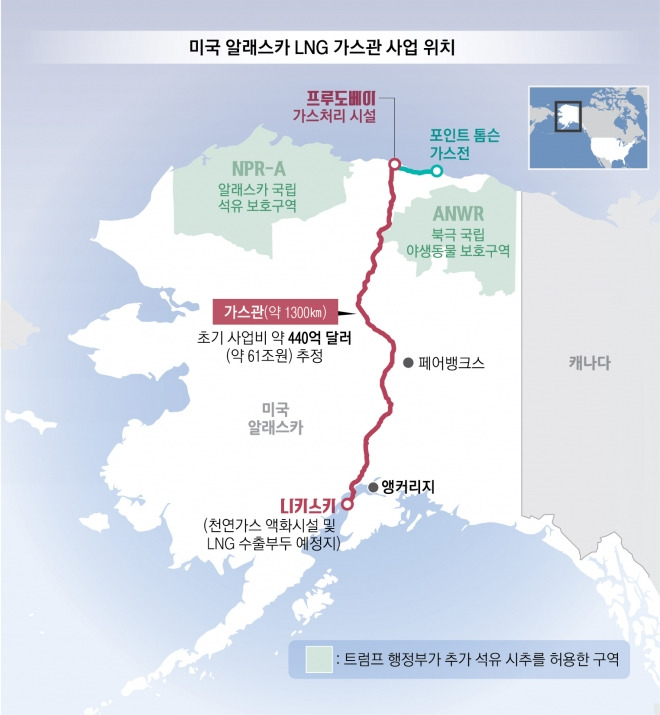
Technical Blueprint of the Project
The project consists of three main components:
- Gas Processing Facility: Processes natural gas from the North Slope region of Alaska.
- Gas Pipeline: An 807-mile (approximately 1,300 km) pipeline that transports processed gas to the southern coast.
- LNG Liquefaction Plant: An annual capacity of 20 million tons (MTPA) LNG export terminal to be built in Nikiski, southern Alaska.
The total estimated cost is about $44 billion, and the developer aims to make a final investment decision (FID) for the first phase of the pipeline by the end of Q4 2025.
Table 1: Alaska LNG Project - Key Indicators
| Parameter | Value | Source |
|---|---|---|
| Lead Developer | Glenfarne Group | 6 |
| Ownership Structure | Glenfarne Group 75%, AGDC 25% | 6 |
| Total Estimated CAPEX | Approximately $44 billion (10-year-old estimate) | 4 |
| Liquefaction Capacity | 20 million tons (MTPA) annually | 11 |
| Target FID (Phase 1) | End of Q4 2025 | 6 |
| Target First LNG Export | After 2030 | 3 |
2. Geopolitical Game Changer: The U.S., Japan, and Korea
The Alaska LNG project transcends mere commercial attempts; it serves as a key tool of U.S. economic diplomacy and a geopolitical variable that digs into the energy security dilemmas of East Asian allies.
U.S. Directive: The Pressure Card on Allies
The Trump administration is leveraging this project as a powerful means to address trade imbalances with Japan and Korea. It is directly linking project participation to the avoidance of high tariffs, thereby pressuring its allies. By packaging Alaska LNG as a ‘safe and stable’ alternative to the Middle East and Russia, it is essentially demanding a geopolitical transaction.
Japan’s Strategic Calculation: A Perfect Alternative?
For Japan, which imports over 90% of its energy, Alaska LNG is seen as an almost perfect strategic alternative that can simultaneously reduce dependence on the Middle East and Russia. Particularly, it aligns perfectly with Japan’s national strategy by reducing the risk associated with its approximately 10% reliance on LNG from Russia and securing a stable supply line from its primary security ally, the United States.
Table 2: Japan’s 7th Basic Energy Plan - 2040 Power Source Composition Goals
| Power Source | 2023 Share (%) | 2040 Target Share (%) |
|---|---|---|
| Renewable Energy | 22.9 | 40-50 |
| Nuclear | 8.5 | About 20 |
| Fossil Fuels (Coal, Oil, LNG) | 68.6 | 30-40 |
Korea’s Dilemma: Choices Under Pressure
In contrast, Korea’s situation is much more complex. While there is a justification for diversifying energy security, it is primarily under pressure from the U.S. for coercive trade negotiations. The threat of high tariffs on key export industries such as automobiles and steel turns the Alaska LNG project into a diplomatic issue that could determine the fate of the national economy rather than a mere energy transaction.
3. Korea’s Dilemma: Between Tariff Bombs and Stranded Asset Risks
For Korea, the Alaska LNG project embodies both ‘opportunity’ and ‘risk’. The government is walking a tightrope between U.S. pressures and domestic policy conflicts, as well as potential industrial opportunities.
The Trap of Tariffs and Government Tightrope
The Trump administration is threatening to impose a 25% comprehensive tariff on all imports from Korea, pressuring participation in the project. In response, the Korean government and Korea Gas Corporation maintain a cautious stance, stating that “thorough economic reviews are a priority” to buy time. This is due to many unresolved risks, including over ten-year-old cost estimates and extreme construction environments.
While Japan is reviewing the project based on a ‘voluntary need’ for diversifying energy supply lines, Korea appears to be more heavily influenced by external pressures such as ’tariff threats’ on its core export industries like automobiles and steel. This could lead to differences in the autonomy both countries have at the negotiation table.
Conflict with Energy Transition Policies
The biggest issue is the conflict with Korea’s long-term energy policies. The ‘2050 Carbon Neutral’ goal and the basic power supply plan indicate a sharp reduction in the share of LNG power generation in the long term. In this context, a large-scale LNG import contract lasting 20 years could undermine the consistency of national policies and pose a risk of ‘stranded assets’ that could lead to significant financial losses in the future. Stranded assets refer to assets that lose value faster than expected due to changes in market conditions, leading to write-offs or conversion to liabilities.
This is the aspect I find most concerning. Given the commitment to carbon neutrality by 2050, is a 20-year contract for massive fossil fuels truly the right choice for future generations? What do you think, dear readers?
Table 3: Korea’s Long-Term Basic Power Supply Plan - Forecast of Power Source Shares (%)
| Power Source | 2030 Target | 2038 Target |
|---|---|---|
| Nuclear | 32.4 | 35.24 |
| Coal | 19.7 | 10.06 |
| LNG | 22.9 | 10.55 |
| Renewable Energy | 21.6 | 32.95 |
Hidden Opportunities for ‘Team Korea’
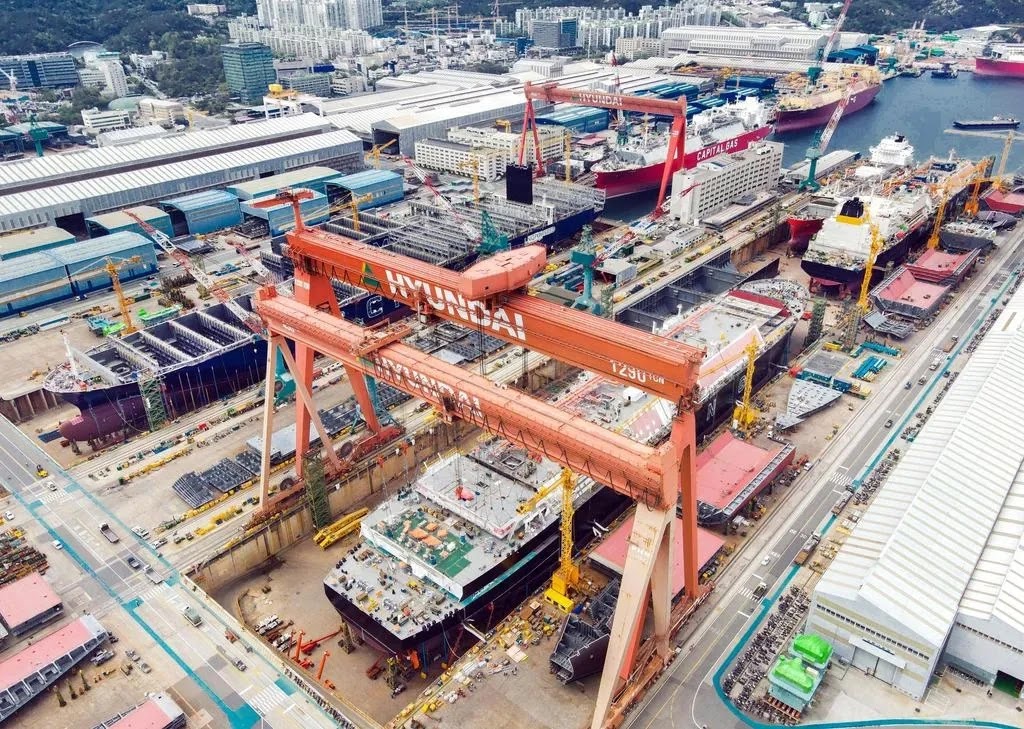
On the other hand, the project also has the potential to provide significant opportunities for Korea’s core industries. The $44 billion construction project could bring contracts worth billions of dollars to EPC companies like Samsung E&A and Hyundai Engineering, along with orders for about 30 new LNG carriers for the Korean shipbuilding industry. However, this is a complex issue that could provoke criticism as ‘privileged benefits for conglomerates backed by public risks from the gas corporation.’
Comparison of Pros and Cons by Participation Scenario
If Korea participates in the project, the following pros and cons can be considered.
| Participation Scenario | Advantages (Opportunities) | Disadvantages (Risks) |
|---|---|---|
| Full Participation (Equity Investment + Purchase Contract) |
Maximized supply stability, improved relations with the U.S., industrial contract opportunities | Huge financial burden, stranded asset risk, exposure to political risks |
| Commercial Participation (Only Private Companies) |
Secured industrial benefits, minimized public burden | Continued U.S. pressure, limited supply stability effects |
| Strategic Non-participation (Refusal to Participate) |
Avoidance of financial risks, consistency with energy transition policies | Intensified trade friction such as tariffs, diplomatic conflicts with the U.S. |
Checklist for Korea’s Response
In this complex situation, stakeholders in Korea should consider the following strategic approaches.
- Independent Business Feasibility Reassessment: Current cost and price competitiveness based on arrival in the Asian market should be thoroughly reassessed, rather than relying on CAPEX from 10 years ago.
- Stranded Asset Risk Modeling: The financial risks of long-term contracts in the future should be quantitatively assessed according to the 2050 carbon neutrality scenario.
- Negotiation Agenda Separation Strategy: Diplomatic efforts are needed to separate LNG purchase contracts from tariff negotiations to escape excessive political pressure from the U.S.
- Securing Contract Flexibility: If negotiations proceed, unfavorable clauses such as volume adjustment options (relaxation of Take-or-Pay) and allowing third-party resale should be minimized.
Conclusion
Korea’s position regarding the Alaska LNG project can be summed up as a ‘dilemma’. The key points are as follows:
- Geopolitical Game: The Alaska LNG project is a geopolitical issue where U.S. foreign policy collides with the national strategies of Korea and Japan, transcending mere energy business.
- Coexistence of Opportunities and Risks: While there are opportunities for strengthening energy security and securing contracts for the shipbuilding and construction industries, there are serious risks of trade pressure from the U.S. and direct conflicts with carbon neutrality policies.
- Need for a Cautious Strategy: Rather than hasty decisions, maintaining ‘strategic ambiguity’ and minimizing risks while maximizing benefits through thorough due diligence and multifaceted negotiation strategies based on national interests is essential.
In this whirlwind of energy geopolitics, it is more important than ever for Korea to find the optimal solution through careful and strategic approaches. Continuous monitoring of the policy decision-making processes of the government and related companies is necessary.
References
- Glenfarne advances to next phase of search for Alaska LNG partners - Natural Gas Intel
- Project Overview - Alaska LNG
- Alaska LNG Project FAQ - AGDC
- Alaska LNG Pipeline (AKLNG) - Global Energy Monitor
- News - Glenfarne Group
- Glenfarne becomes lead developer for the ALASKA LNG PROJECT - Glenfarne Energy Transition
- [In-depth Analysis] Alaska LNG Development Gaining Momentum… U.S. Pressures Korea for Participation Linked to Tariffs - Global Economic
- Glenfarne announces over $115 billion of strategic partner interest for Alaska LNG - Glenfarne Group
- India-U.S. Energy Relations: GAIL Pushes for Deal with Trump-Supported Alaska LNG Project - Times of India
- Wood Mackenzie – Alaska LNG Competitiveness Analysis
- Three Years into the Ukraine War, Japan’s Efforts for Stable LNG Supply - The Japan Times
- Japan’s 7th Strategic Energy Plan - Energy Tracker Asia
- Despite U.S. Pressure on ‘Alaska LNG Imports’… Government Says ‘Judgment Possible Only After October’ - Chosun Biz
- U.S. Tariff Measures and Korea-U.S. Trade - Congressional Research Service
- Korea’s Energy Mix and 10th Basic Energy Plan - Energy Tracker Asia
- Korea’s 11th Power Plan Makes Partial Progress Towards Decarbonization - IEEFA