
Unpacking the Meaning of the 15% Tariff and $350 Billion Investment.
- Key conditions of the new ‘managed trade’ system
- Pros and cons for major industries like automobiles and semiconductors
- The truth behind the $350 billion investment mystery
A New Korea-US Economic Alliance: The Era of Managed Trade
On July 31, 2025, a new Korea-US Trade Agreement was concluded between South Korea and the United States. This agreement signifies the introduction of a new ‘managed trade’ system that effectively replaces the existing Korea-US FTA. It suggests a shift from norm-based free trade to a transactional relationship that allows market access based on large capital investments.
The core of the agreement includes ▲ reducing US tariffs on Korean products from 25% to 15% ▲ a $350 billion investment from Korea to the US ▲ a commitment to purchase $100 billion worth of US energy. However, significant discrepancies exist between the two countries regarding details such as ‘full opening of the Korean agricultural market’ and the structure of investment profit distribution, leaving room for future disputes.
In conclusion, while this agreement avoids the worst-case scenario of a ‘25% tariff’, it is a result of a practical choice that incurs substantial costs. So, what will be the specific impact on our economy?
Key Conditions of the 2025 Korea-US Trade Agreement
This agreement presents a completely different paradigm from past FTAs. The structure linking tariff adjustments with large-scale investment and purchasing commitments clearly shows a change in the nature of economic relations between the two countries.
15% Tariff System: From Free Trade to Managed Equivalence
The most significant change is the reduction of the US tariff rate on Korean products from the initially discussed 25% to 15%. This means we will now be subject to the same tariff rate as Japan and the EU, thus avoiding the worst-case scenario.
However, this also means the loss of the preferential status enjoyed under the Korea-US FTA, particularly the duty-free benefit for the automotive industry. Our negotiating team argued for 12.5%, but could not overcome the US’s policy of applying 15% uniformly to major trading partners.
Interestingly, there is a difference in interpretation regarding the term ‘reciprocal tariff’. The South Korean government announced that both countries would impose a 15% tariff on each other, while President Trump declared, “The US will not be subject to any tariffs.” This indicates a potential source of future controversy.
Table 1: Summary of Key Conditions of the 2025 Korea-US Trade Agreement
| Item | Content | Remarks |
|---|---|---|
| General Tariff | 15% tariff on exports of Korean products to the US | Discrepancy in import tariffs on US products (Korea: 15%, US: 0%) |
| Automotive Tariff | 15% | Increased from 0% under the previous Korea-US FTA |
| Steel/Aluminum | Unclear (possibility of high tariffs and elimination of existing quotas) | Potential deterioration compared to the 2018 agreement |
| Investment Commitment | $350 billion investment from Korea to the US | Key countermeasure for the agreement’s conclusion |
| Energy Purchase | Commitment to purchase $100 billion worth of US energy | Aimed at reducing the US trade deficit |
| Advanced Industries | Most-Favored-Nation (MFN) treatment for semiconductors, pharmaceuticals, etc. | Securing conditions not less favorable than competitors |
$350 Billion Investment Obligation and $100 Billion Energy Purchase
At the heart of this negotiation is Korea’s commitment to a $350 billion investment in the US. This was a key condition demanded by the US in exchange for lowering the tariff rate to 15%.
President Trump announced that this investment would be “controlled by the US”, while our government explains that it aims to support the entry of our companies into the US market in sectors like shipbuilding and semiconductors. Additionally, the commitment includes purchasing $100 billion worth of US LNG and other energy sources.
Industry-Specific Impact: Opportunities and Crises
This agreement casts different shadows on our major industries.
Automotive Industry: The Beginning of Strategic Restructuring
The imposition of a 15% tariff on the automotive industry is one of the biggest shocks. We have now lost the price competitiveness advantage of 0% tariffs under the Korea-US FTA, and we are now on the same starting line as Japanese and European competitors.
Analysts estimate that this tariff will reduce Hyundai and Kia’s annual operating profit by approximately 1.65 trillion won. This has further highlighted the strategic importance of Hyundai’s local production facilities in Georgia and Alabama. The industry will need to explore a complex response strategy, including raising local selling prices, reducing incentives, and increasing local production ratios.

Steel and Aluminum: Unresolved Quota Issues
In 2018, we accepted a quota system that limited export volumes in exchange for exemption from a 25% steel tariff. However, this agreement puts us at risk of nullifying the 2018 agreement. In the worst case, there is a possibility of facing high tariffs of up to 50%, leaving the steel industry facing greater uncertainty.
Agriculture: Two Stories
The biggest controversy revolves around the issue of opening the agricultural market. President Trump announced that Korea would “completely OPEN” its agricultural market, but our presidential office firmly refuted that there would be no additional opening for sensitive items like rice and beef.
This difference in stance appears to be a ‘deliberate ambiguity’ strategy employed by both governments for domestic political purposes. Although rice and beef have been preserved, the potential for future non-tariff barrier issues remains, leaving the agricultural sector as a potential flashpoint for renewed conflict.
Table 2: Discrepancies in Official Announcements (US vs. Korea)
| Topic | US Government Position | South Korean Government Position |
|---|---|---|
| Agricultural Market Access | “Korea will be completely open to trade with the US.” | “There will be no additional opening of the domestic rice and beef markets.” |
| Investment Fund Profits | “90% of the profits will go to Americans.” | “It’s not about giving up 90% of profits but rather a reinvestment concept.” |
| Control of Investment Fund | “The US will own and control it, and I, the president, will choose.” | “A fund to help our companies enter the US market.” |
Strategic Growth Industries: Semiconductors and Biotech
Fortunately, provisions guaranteeing Most-Favored-Nation (MFN) treatment for advanced industries like semiconductors and pharmaceuticals have been included. MFN refers to the principle of granting the most favorable trade conditions given to one country to all other member countries equally. While this does not guarantee duty-free status, it is a promise not to apply less favorable tariff conditions than competitors, serving as an important safeguard to alleviate uncertainties in our future growth industries.
Analyzing the $350 Billion Investment Mystery
The $350 billion investment commitment in the US, which is the price of this negotiation, raises numerous questions. I remember being surprised by the scale and conditions when I first heard this news.
Structure, Control, and the ‘90 to 10’ Profit Distribution Controversy
The biggest controversy stems from Secretary of Commerce Howard Rutnik’s statement that “90% of the investment profits will go to Americans.” Our government strongly rebutted this by stating, “It’s not about giving up 90% of profits but rather a reinvestment concept.” Such differing interpretations indicate that a fierce tug-of-war over fund management between the two countries has already begun.
$150 Billion Shipbuilding Cooperation Fund: A Strategic Lever
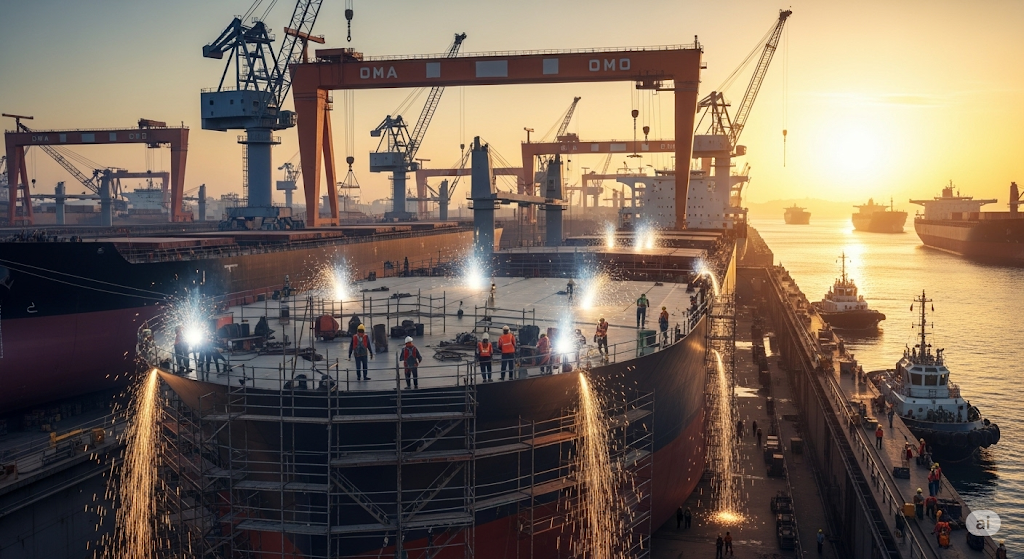
Notably, a whopping $150 billion of the total $350 billion has been designated as a ‘shipbuilding cooperation fund’. This is analyzed as Korea providing capital and technology to help rebuild the US shipbuilding industry, and in return, our companies gain access to the US market, which has been blocked by strong protectionist barriers like the Jones Act, creating a ‘quid-pro-quo’. This could serve as a new foothold for our world-class shipbuilding industry.
Comparison of the Korea-US Trade Agreement with Other Countries
The $350 billion promised by Korea corresponds to about 19% of our GDP, which is a substantial amount. How does this compare to other countries that concluded negotiations around the same time?
Table 3: Recent Comparative Analysis of US Trade Agreements (Korea, Japan, EU)
| Item | South Korea | Japan | EU |
|---|---|---|---|
| Agreed Tariff Rate | 15% | 15% | 15% |
| Investment Commitment (USD) | $350 billion | $550 billion | $1.2 trillion |
| Investment/GDP Ratio | About 19% | About 13.6% | About 7.1% |
| Claimed Profit Distribution (US) | 90% | 90% | 90% |
The government explained that the fund structure is ‘guarantee-centered’, so the actual burden is low, and excluding the shipbuilding fund we lead, the actual investment scale is at the level of 36% of Japan’s. However, it is difficult to avoid the assessment that we have taken on a relatively large burden compared to the size of our economy.
Conclusion: The Beginning of a New Negotiation
The 2025 Korea-US Trade Agreement marks a significant turning point for our economy and alliance. To summarize the key points:
- Costs: We have lost the preferential status of the Korea-US FTA and taken on an astronomical investment obligation of $350 billion.
- Benefits: We have avoided a catastrophic tariff scenario of 25% and laid the groundwork for cooperation with the US in sectors like shipbuilding.
- Challenges: Ambiguous clauses regarding tariff imposition, investment fund governance, and agricultural issues suggest that this agreement is not the end but the beginning of a new negotiation.
In conclusion, Korea has paid a high price for stability, but at the same time, efforts have been made to embed strategic opportunities within that concession. Now is the time for the government and businesses to come together as a team to devise specific execution plans on how to leverage this strategic investment. Whether we can turn a defensive negotiation outcome into aggressive economic territorial expansion is now put to the test.